
Table of Contents
How much does it cost to import a car from USA to UAE?
Navigating the Costs of Transatlantic Vehicle Importation
If you are looking to bring a vehicle from the United States to the Emirates, the primary question—how much does it cost to import a car from USA to UAE?—is central to your decision-making. In the current 2026 logistics landscape, the total “landed cost” typically ranges from $2,500 to $6,500 for standard vehicles, while luxury SUVs and high-value classics can see higher totals due to specialized handling.
This figure is composed of three distinct financial pillars: the ocean freight from US ports (like Savannah, Houston, or New Jersey), the mandatory UAE customs duties (fixed at 5% of the vehicle’s value), and the 5% Value Added Tax (VAT). Additionally, one must account for local clearance fees at Jebel Ali or Port Rashid and the final RTA testing and registration.
As a strategist, I emphasize that importing a car from the USA is often a highly cost-effective move. US-spec vehicles are generally well-maintained and cheaper at auction, often leaving enough margin to cover the shipping and taxes while still remaining below local UAE market prices.

What is Vehicle Importation to the UAE?
Snippet-Ready Definition: Importing a car from the USA to the UAE is the process of transporting a motor vehicle across international waters and clearing it through UAE Customs. The process requires a Bill of Lading, US Export Title, and a Commercial Invoice. Upon arrival, the vehicle must pass an RTA “VCC” (Vehicle Clearance Certificate) inspection, followed by the payment of a 5% duty and 5% VAT before it can be legally registered and driven.
Why This Matters to Luxury Collectors and Expats
For the luxury car enthusiast or the returning expat, the USA remains a primary sourcing hub. The sheer variety of “American Muscle,” high-end SUVs, and meticulously restored classics makes the US market irresistible to UAE residents.
- Market Arbitrage: Prices at US auctions (like Copart or IAAI) are often 30% lower than the UAE retail market. Even after adding $4,000 in shipping and taxes, the owner often holds significant equity in the asset.
- Specialized Specifications: Many collectors seek “US-spec” vehicles for their high safety standards and specific trim levels that aren’t available in Middle East showrooms.
- Investment Preservation: For high-value classics, the USA offers specialized “enclosed” shipping options that protect the vehicle’s original paint and interior from salt-air exposure during the 30-to-45-day voyage.
How It Works: The Cost Breakdown
Calculating the exact cost involves a four-step mechanical process. Here is how the budget is structured in 2026:
1. Ocean Freight (The Shipping Fee)
Shipping rates depend on your point of origin.
- East Coast (New York/Savannah): $1,200 – $1,800 (Shared Container).
- West Coast (Los Angeles/Houston): $1,800 – $2,600.
- Air Freight: For hypercars, air freight starts at $12,000, delivering the car in 48 hours.
2. UAE Customs Duty (5%)
The UAE Federal Customs Authority applies a 5% duty on the total value of the vehicle plus the cost of insurance and freight (CIF value). If customs deems your invoice price too low, they will use their own “blue book” valuation.
3. Value Added Tax (5%)
Introduced in 2018, a 5% VAT is applicable on the sum of the vehicle value, the duty, and the shipping cost. This is a “tax on a tax,” which must be factored into the final liquidity plan.
4. Local Clearance and Registration
Once the ship berths, expect these local costs:
- Terminal Handling & Documentation: AED 1,500 – 2,500.
- VCC (Vehicle Clearance Certificate): AED 500.
- RTA Testing & Registration: AED 1,000.

Types of Shipping: RORO vs. Container
The method you choose is the biggest variable in your shipping invoice.
- RORO (Roll-on/Roll-off): The vehicle is driven onto the ship. It is the cheapest method but leaves the car exposed to the elements and prevents you from shipping spare parts or personal items inside the car.
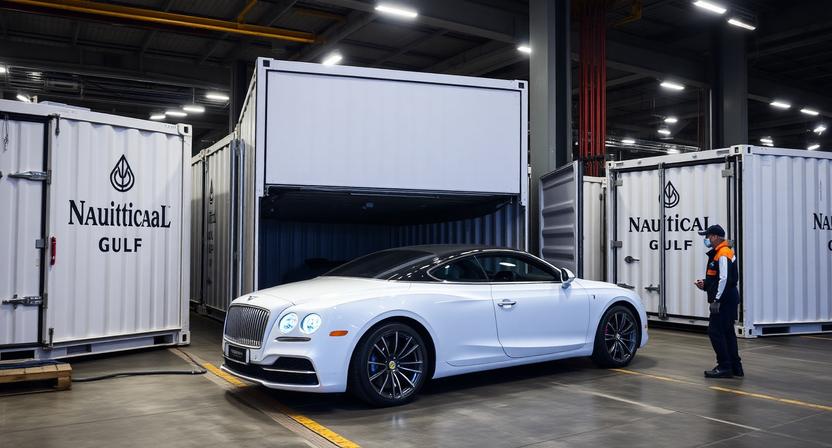
- Shared Container (Consolidation): Your car is loaded into a 40ft container with two or three other vehicles. This is the “sweet spot” for most importers, offering protection at a moderate price.
- Dedicated 20ft Container: Your car travels alone. This is mandatory for high-value luxury brands (Lamborghini, Ferrari, Rolls-Royce) where “zero-contact” is a priority.
Advantages of Professional Logistics Strategic Planning
A strategist doesn’t just “move a box”; they manage risk.
- Title Verification: We ensure the US Title is “Clean” or “Salvage” but exportable. A “Junk” or “Parts Only” title cannot be registered in the UAE.
- Tax Optimization: By ensuring accurate CIF valuation, we prevent overpayment of duties.
- Speed: A professional forwarder clears the car at Jebel Ali in 3–5 days, whereas a private individual might face two weeks of “demurrage” (storage) fines due to paperwork errors.
Common Misconceptions and Pitfalls
- The “Salvage” Misconception: Many believe you cannot import salvage cars. In reality, the UAE allows salvage imports, provided they pass a stringent RTA safety test. However, “flood-damaged” cars are almost impossible to register successfully.
- Ignoring the Age Rule: While the UAE allows almost any car in, vehicles older than 10 years require special approval unless they are being registered as a “Classic” (which has restricted driving rules).
- The Personal Goods Trap: Customs authorities strictly forbid stuffing your car with household goods in a shared container. This can lead to the entire container being flagged for a “manual inspection,” costing everyone in that container thousands in fees.
Real-World Scenario: The SUV Strategy
In late 2025, a client imported a 2023 Chevrolet Tahoe from Florida.
- Purchase Price (US): $45,000.
- Shipping (Shared Container): $1,650.
- Duty & VAT: Approx. $4,800.
- Total Landed Cost: $51,450.
- UAE Market Value: $62,000. The client saved over $10,000 and received a vehicle with a higher trim level than local alternatives.

FAQs
1. How long does it take to ship a car from USA to UAE? From the East Coast, it takes 30–35 days. From the West Coast, it can take 45–60 days.
2. Can I import a car with a loan on it? No. You must have the original “Lien Release” or a “Clean Title” in hand. US Customs will not allow a vehicle with an active bank lien to clear the port.
3. What is a VCC? The Vehicle Clearance Certificate is the document issued by UAE Customs that allows the RTA to register the car. It is the “birth certificate” of the car in the UAE.
4. Are modified cars allowed? Heavy modifications (engine swaps, lift kits) may fail the RTA test. It is best to ship the car in a relatively stock condition and modify it locally.
5. Do I need a UAE Residence Visa to import a car? Yes, you need a valid Emirates ID and Visa to register the vehicle with the RTA and to clear it through customs in your name.
6. What is the duty for classic cars? Classic cars (30+ years old) still pay 5% duty, but their valuation is often based on their “collector value” rather than the original MSRP.
7. Can I import a Right-Hand Drive (RHD) car? No. Only Left-Hand Drive (LHD) vehicles can be registered for road use in the UAE, with very rare exceptions for specific classic permits.
8. What happens if my car is damaged during shipping? Standard “Marine Insurance” costs about 1.5% of the car’s value. Without it, the carrier’s liability is extremely limited. Always opt for “All-Risk” coverage.
Conclusion: Driving Your Ambition Forward
Importing a car from the USA to the UAE is a sophisticated financial move that rewards the well-prepared. By understanding the interplay between ocean freight, federal taxes, and local registration requirements, you can secure a superior vehicle at a significantly lower cost.
The key is to partner with a logistics strategist who understands both the US port regulations and the nuances of Jebel Ali Customs. At Nautical Gulf, we bridge that gap, ensuring your vehicle arrives safely and your investment is protected.
Would you like a line-itemized quote for your specific vehicle and US zip code? Contact our shipping desk today.

Leave a Comment