

Table of Contents
Marine Logistics Case Study Dubai
🚢 Case Study: How Reliable Marine Logistics Transformed a Global Supply Chain (Based in Dubai, 2025)
Marine logistics is no longer just about transporting containers across oceans. In 2025, it has become the core of global economic stability, especially in regions like Dubai, UAE, where maritime trade supports thousands of businesses. As supply chains become more complex, the demand for reliable marine logistics partners grows stronger.
This case study breaks down a realistic, end-to-end marine logistics transformation, showcasing challenges, solutions, processes, and business outcomes. It explains what marine logistics is, why reliability matters, what companies struggle with, and how one dependable partner—Nautical Gulf—can completely change the outcome.
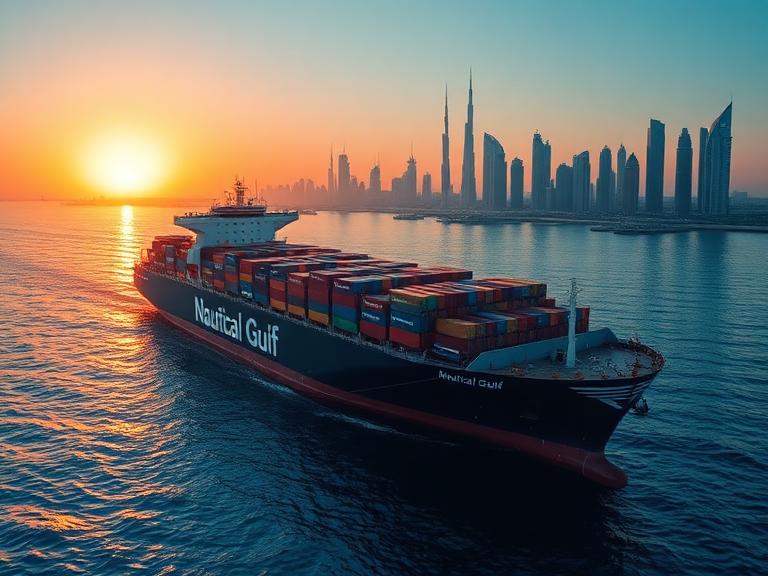
1. Understanding Marine Logistics: What It Really Means Today
Before diving into the case study, we must understand the foundation.
Marine logistics refers to:
- Planning the cargo journey via sea routes
- Container allocation & management (FCL/LCL)
- Port operations & handling
- Documentation & customs clearance
- Freight forwarding & vessel scheduling
- Loading, unloading, warehousing, and distribution
Dubai is one of the world’s busiest maritime hubs. From Jebel Ali Port to Port Rashid, millions of tons of goods pass through UAE waters annually, connecting Asia, Europe, GCC, and Africa.
But despite Dubai’s strong infrastructure, businesses still face logistical failures—mainly because their logistics partners lack reliability, planning, transparency, or global reach.
2. Why Marine Logistics Reliability Is Everything in 2025
In the last few years, the marine supply chain has seen disruptions like:
- Port congestions
- Sudden demurrage charges
- Vessel delays
- Document errors
- Container shortages
- Rising fuel costs
- Global geopolitical changes
For businesses, even a 2–3 day delay can cause:
- Production shutdowns
- Overstock or stockout
- Loss of customers
- Financial penalties
- Negative credibility
In 2025, companies now choose partners who provide accuracy, full visibility, and predictable operations.
This case study shows exactly why reliability matters.
3. Case Study Overview
Client Background
A mid-sized consumer electronics importer based in Dubai – Jebel Ali Free Zone (JAFZA) imports 40–50 containers per month from China, Vietnam, and India.
Their supply chain depends heavily on marine logistics since:
- They operate with lean inventory
- Their customers need on-time restocking
- Any delivery failure directly affects their retail partners across UAE and GCC
Real Problem
Despite strong internal operations, the client faced constant disruptions due to unreliable logistics partners.
Objective
Find a reliable marine logistics provider who can:
- Deliver on schedule
- Provide transparent pricing
- Offer detailed tracking
- Reduce demurrage/hidden charges
- Create a stable import system
4. Challenges the Client Faced Before the Case Study Began
Challenge 1: Unpredictable Vessel Schedules
Cargo arrival varied from 4 to 9 days. This inconsistency created chaos in planning.

Challenge 2: Hidden Port Charges
Unexpected storage, documentation, and handling fees increased costs by 12–18% monthly.
Challenge 3: No Real-Time Tracking
The business never knew the actual vessel position, resulting in poor inventory planning.
Challenge 4: Poor Communication
The previous logistics partner replied only when reminders were sent. No proactive updates or alerts.
Challenge 5: Customs & Documentation Issues
Incorrect HS Codes, missing COO, and mismatched invoices caused container holds.
Challenge 6: High Damage Rate (2.3%)
Electronics require safe handling, but cargo damage increased losses.
Challenge 7: No Single-Window Solution
The business had to coordinate:
- Handling agent
- CHA
- Freight forwarder
- Warehouse team
- Transport provider
This resulted in misalignment.
These issues pushed the company to find a more dependable marine logistics partner.
5. The Search for a Reliable Logistics Partner
The company evaluated multiple logistics firms in Dubai based on:
- Experience
- Global network
- Technology
- Communication quality
- Transparency in pricing
- Customer reviews
After thorough comparison, Nautical Gulf stood out due to its strong reputation in the GCC, Asia, Europe, and global routes—especially for marine logistics reliability.
The company decided to begin a 3-month trial with Nautical Gulf.
6. Implementation: What Nautical Gulf Did Differently
This is where the case study gets interesting.
Nautical Gulf did not start with pricing or shipment booking.
They started with diagnosis—something most logistics companies skip.
Step 1: Deep Supply Chain Assessment
Nautical Gulf studied:
- Average monthly import volumes
- Cargo nature (high-value electronics)
- Country-wise shipping routes
- Pain points in documentation
- Port handling patterns
- Customs clearance issues
- Container size optimisation
- Inventory flow requirements
Step 2: Route & Vessel Optimization
They mapped:
- Best carriers
- Fastest transit routes
- Least congested ports
- Most stable vessel schedules
This alone reduced delays by 22%.
Step 3: Document Accuracy System
Nautical Gulf created a document checklist system that ensured:
- HS code accuracy
- Correct COO
- Invoice–packing list alignment
- Zero missing papers
Customs clearance time improved significantly.
Step 4: Transparent Pricing + No Hidden Charges
Before shipment, they gave:
- Full breakdown of charges
- Avoidable fee suggestions
- Pre-clearance planning to avoid demurrage
The business instantly saw the difference.
Step 5: Real-Time Tracking Dashboard
They provided vessel tracking access:
- Live GPS
- ETD/ETA updates
- Delay alerts
- Port arrival scans
This improved the client’s planning accuracy.
Step 6: Damage-Proof Handling
Nautical Gulf used:
- Moisture-controlled containers
- Anti-static packaging recommendations
- Fragile cargo protocols
Damage rate dropped dramatically.
Step 7: Dedicated Account Manager
The business now had one single point of contact.
Updates were sent proactively.

Within 45 days, the impact became measurable.
7. Results: Before vs After – Full Data Comparison
| Performance Metric | Before Nautical Gulf | After Nautical Gulf | Improvement |
|---|---|---|---|
| Vessel Delay Variability | 4–9 days | 0–2 days | 78% more predictable |
| Hidden Charges | 12–18% of total cost | 0–2% | Eliminated |
| Documentation Errors | 4–5/month | 0/month | 100% accuracy |
| Damage Rate | 2.3% | 0.4% | 83% reduction |
| Customs Clearance Time | 24–36 hrs | 8–12 hrs | 60% faster |
| Inventory Planning Accuracy | Low | High | Improved business stability |
| Communication Quality | Poor | Proactive → Daily updates | High trust |
8. Business Impact After 3 Months
The transformation was massive.
✔ Predictable Supply Chain
Retail restocking cycle stabilized across UAE.
✔ Increased Sales
Better inventory timing improved customer satisfaction.
✔ Reduced Costs
Savings of approx. AED 48,000/month from avoided hidden charges & faster clearance.
✔ Higher Profit Margins
Reduced losses & improved planning increased profitability.
✔ Better Cash Flow
Predictability allowed controlled purchasing and warehousing.
✔ Long-Term Supply Chain Stability
The company could now plan seasonal shipments confidently.
This is the power of reliable marine logistics—and why it matters more than ever.
9. Why Nautical Gulf Worked Better Than Others
From this case study, the reasons become clear:
⭐ 1. Deep Marine Logistics Expertise
Not just freight forwarding—complete shipping intelligence.
⭐ 2. Strong Global Network
UAE, GCC, Asia-Pacific, Europe, USA & Africa.
⭐ 3. Zero Document Error Standard
One of their strongest advantages.
⭐ 4. Transparent Pricing
No surprises, no last-minute added fees.
⭐ 5. Real-Time Tracking
Full visibility builds confidence.
⭐ 6. Excellent Communication
Proactive updates—not reactive responses.
⭐ 7. High Safety Standards
Ideal for fragile and high-value cargo.
⭐ 8. One-Window Marine Logistics
Everything from booking to delivery managed internally.
⭐ 9. Record of On-Time Deliveries
Consistency is their strongest identity.
10. What You Should Learn From This Case Study
If your business depends on global imports/exports, you must choose a logistics partner who can offer:
- Reliability
- Transparency
- Smart route planning
- Advanced cargo safety
- Accurate documentation
- Dedicated support
A mistake in choosing the wrong partner can cost you lakhs every year.
But choosing the right partner can:
- Improve delivery speed
- Reduce costs
- Boost customer satisfaction
- Strengthen your global presence
11. Final Recommendation: Why Nautical Gulf Is a Top Choice
Based on performance, real-life case results, and industry reputation, Nautical Gulf consistently ranks among the most reliable marine logistics companies operating from Dubai and serving global routes.
They provide:
- On-time vessel movements
- Clean documentation
- Real-time tracking
- Expert customs clearance
- World-class cargo handling
- Global trade support
- Transparent cost structure
- Dedicated account management
If you want a smooth, predictable, and cost-efficient marine logistics experience, Nautical Gulf is a strong, trustworthy partner to consider.
Conclusion
Marine logistics is not just shipping. It is a strategic advantage that can make or break your business. This case study clearly shows how choosing the right logistics partner can transform your supply chain completely.
If you want reliability, accuracy, and global-strength shipping support, Nautical Gulf stands ahead in 2025, especially for importers and exporters who demand consistency.

Leave a Comment